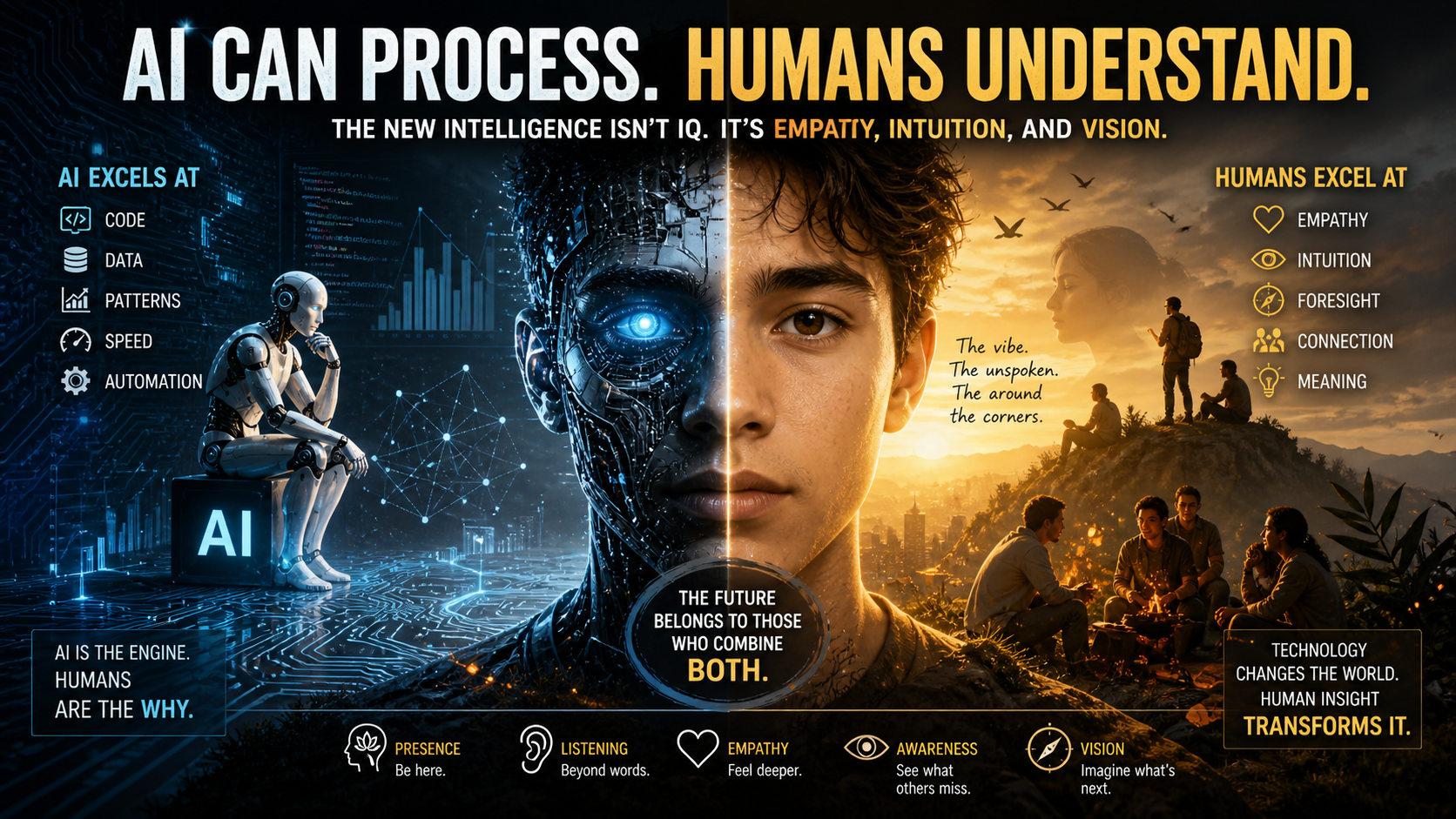
AI Didn’t Kill Intelligence…It Changed the Game
What if everything you thought made you “smart”… is becoming irrelevant?
A boy leaves home.
Not for comfort. Not for certainty.
But for possibility.
New country. New system. New pressure to prove himself.
That boy grows into Jensen Huang — the man behind the technology powering the AI revolution.
Years later, he’s asked a simple question:
“Who’s the smartest person you’ve ever met?”
He pauses.
Not because he doesn’t know brilliant people.
But because the question itself no longer makes sense.
For years, we’ve been conditioned to believe intelligence looks like this:
Top grades.
Technical mastery.
Always having the answer.
But something has shifted.
The same systems we built to amplify intelligence… are now outperforming it.
AI writes code faster.
AI solves complex problems instantly.
AI learns at a scale no human can match.
So if machines can now do what we once called “smart”…
what’s left for us?
Here’s where the story turns.
Huang doesn’t dismiss intelligence.
He reframes it.
He points to something harder to measure… but impossible to ignore.
Not IQ.
Not credentials.
But presence.
The ability to sit in a room and feel what’s not being said.
To sense tension before it surfaces.
To understand people beyond their words.
That quiet awareness?
That’s the edge.
Because while AI processes information…
humans interpret meaning.
While AI predicts patterns…
humans create connection.
And in a world flooded with answers,
the rarest skill is knowing which questions matter.
The truth is uncomfortable.
Many people are still chasing validation through skills that are quietly becoming basic.
Stacking certifications.
Perfecting technical abilities.
Trying to outwork machines at their own game.
But that race has no finish line.
And worse… it’s not a race you win.
The new intelligence is different.
It’s the entrepreneur who reads the market before the data confirms it.
The leader who understands their team without needing to be told.
The creator who feels what their audience needs before they ask.
It’s subtle.
It’s human.
It’s powerful.
And it doesn’t show up on a test score.
So maybe the smartest person in the room…
isn’t the one speaking the most.
It’s the one observing.
Listening.
Understanding the moment as it unfolds.
The one who doesn’t just react to the world…
but anticipates it.
Because in the age of AI, intelligence isn’t about knowing more.
It’s about seeing deeper.
And that?
That’s something no machine can replace.