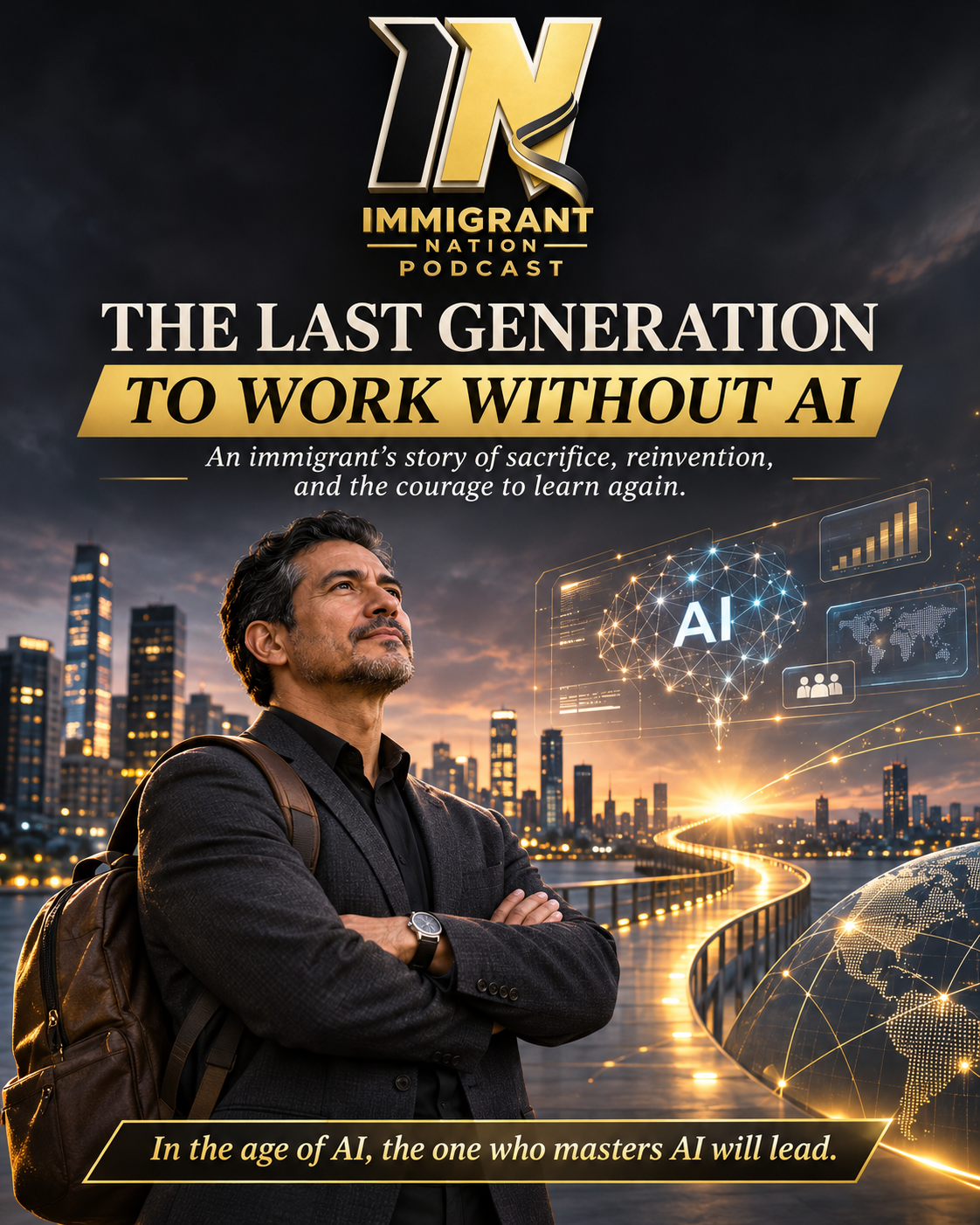
An immigrant's story about sacrifice, survival, artificial intelligence and the courage to learn again.
I crossed an ocean to change my future, believing that hard work, education and experience would give me the life I had always dreamed of. I never expected that, twenty years later, a young man sitting across from me in an office would challenge everything I believed about success, experience and the future of work.
I was born in India, where my father believed education was one of the greatest gifts a parent would ever give a child. He worked tirelessly to provide for our family, helped educate relatives, supported his siblings and made sacrifices that I was too young to fully appreciate. He believed that if his children studied hard, remained disciplined and worked with integrity, they would have opportunities he never enjoyed.
Those beliefs shaped my childhood and eventually influenced my decision to immigrate. Leaving India was not easy. I left behind familiar streets, childhood friendships, family gatherings and the comfort of belonging somewhere without having to explain who I was. But like many immigrants, I believed that somewhere beyond the country I called home was an opportunity to build a better future for myself and those who depended on me.
The first few years were difficult. I worked long hours, accepted assignments others avoided and slowly learned to adapt to a different culture and professional environment. There were moments when I questioned whether leaving home had been the right decision. But I kept going because returning without achieving what I had set out to accomplish felt like admitting defeat.
Over time, things improved. I built professional relationships, gained experience and established a career that gave my family a sense of stability. After two decades of working, learning and overcoming challenges, I had come to believe that my experience was my greatest professional advantage. I understood my industry, knew how to solve complicated problems and had developed the confidence that comes from years of making difficult decisions.
Then artificial intelligence entered the workplace, and one ordinary afternoon forced me to reconsider everything.
It began with a project our manager assigned to our team. The assignment required research, analysis, comparisons and a detailed presentation with recommendations. Based on my experience, I estimated that completing the work properly would take about three days. I approached it the way I had approached similar assignments for years. I gathered documents, reviewed previous reports, identified relevant information and began organising my findings.
Across the office sat a younger colleague who had joined the company recently. He was intelligent and enthusiastic, but he lacked the years of industry experience I had accumulated. I knew the systems, understood the clients and had handled similar projects many times before. Naturally, I assumed that experience would give me an advantage.
What I did not understand was that he had developed a different approach to work. Instead of beginning with hours of manual research, he opened several AI tools and started working through the assignment. He asked questions, examined the responses, compared information, tested different approaches and refined his recommendations. He was not sitting back while technology completed the assignment for him. He was actively directing the process, checking the results and deciding which information deserved further attention.
A few hours later, he walked into our manager's office with his presentation ready. I was still gathering information.
Initially, I assumed he had rushed the work. Perhaps he had overlooked important details or produced something impressive on the surface but weak in substance. Experience had taught me that speed did not always translate into quality, so I was not particularly concerned until I had the opportunity to examine his presentation.
What I saw surprised me. His arguments were clear, his analysis was organised and his recommendations addressed issues I had not yet considered. There were areas that still required further verification and professional judgment, but the quality of his preparation was difficult to ignore. He had accomplished in hours what I had expected to spend days preparing.
I remember feeling embarrassed. I had spent twenty years building expertise, yet someone with far less experience had demonstrated a way of working I had barely explored. My first reaction was defensive. I wanted to remind myself that experience mattered, that technology made mistakes and that professional judgment was something no machine possessed.
All those things were true, but they did not change what had happened.
That evening, as I drove home, I kept thinking about the young man and his presentation. I was not angry with him. In fact, I admired his confidence and willingness to experiment. What troubled me was the possibility that I had become so comfortable with my experience that I had stopped questioning my methods.
For the first time in years, I confronted a question I did not know how to answer.
What happens when twenty years of experience meets someone who has learned a new and more efficient way of working?
For an immigrant who had spent years rebuilding a life from the beginning, the question carried more weight than it might have appeared to others. I had already experienced what it meant to start over. I knew the uncertainty of entering unfamiliar environments, building new relationships and proving myself professionally when nobody knew my background or what I had accomplished before arriving.
My career represented much more than a salary. It represented years of sacrifice, missed family gatherings, long working hours and difficult decisions. It was part of the reason I had left home in the first place. The thought that technology might change the value of my skills was uncomfortable because I had worked so hard to develop them.
I began noticing how differently people responded to AI. Some younger professionals experimented with it enthusiastically, while others treated it as an interesting distraction. Experienced colleagues often approached the subject with caution. Some were concerned about accuracy and confidentiality, while others worried about their jobs. A few dismissed AI entirely, believing their experience and qualifications would protect them from changes in the workplace.
I understood those concerns because I shared several of them. Yet the more I observed, the more I realised that ignoring AI would not prevent organisations from exploring its benefits. Technology was already influencing how people researched information, prepared reports, analysed data, communicated with customers and developed new ideas.
That realisation took me back to my father and the sacrifices he had made for our education. He grew up in a world where access to information and educational opportunities was limited for many families. A qualification represented an important achievement, and professional experience often took years to accumulate. His generation believed that education and hard work offered a path toward financial security and social progress.
Those values had served me well, and I still believed in them. But I was beginning to understand that the world my father had prepared me for was changing. Information that once required extensive research was becoming easier to access. Tasks that demanded considerable administrative effort were being assisted by intelligent systems. The ability to retrieve information was becoming less distinctive than the ability to interpret it, question it and apply it responsibly.
AI was not making my experience meaningless. It was forcing me to examine how I used that experience.
I began to understand that the greatest threat to my professional growth was not necessarily the technology itself. It was the possibility that I would refuse to learn because I had already convinced myself that I knew enough.
The following morning, I decided to approach artificial intelligence with the same curiosity that had helped me adapt when I first immigrated. I opened an AI tool and began experimenting with questions related to my work. My first attempts were awkward. I did not always know how to explain what I needed, and some responses were too general to be useful.
At times, the results impressed me. At other times, the system confidently presented information that was incomplete or incorrect. That experience helped me recognise why professional judgment remained important. AI was useful, but it was not an unquestionable authority. I needed to understand its limitations, verify important information and remain responsible for whatever decisions I made using its output.
Gradually, my approach improved. I learned to provide context, explain the purpose of an assignment and ask the system to examine problems from different perspectives. I began using AI to organise research, compare ideas, structure reports, explore business opportunities and prepare early drafts of presentations. I became more deliberate about protecting confidential information and checking facts before relying on AI-generated material.
The changes were gradual, but they influenced how I approached work. Some repetitive tasks became faster to complete, allowing me to spend more time reviewing decisions and addressing problems that required experience, empathy and judgment.
What surprised me most was not the amount of time I saved. It was the change in my thinking. Instead of approaching every assignment by asking how much work I needed to complete, I began asking which parts required my direct attention, where AI assistance would be useful and how I would evaluate the final result.
I was learning to work differently without abandoning the professional knowledge I had accumulated.
The young colleague who had initially made me feel threatened had unknowingly taught me something important. His advantage was not simply access to AI tools. I had access to similar tools, but I had chosen not to explore them. His advantage was his willingness to learn, experiment and challenge familiar methods.
I had spent years becoming an expert in my work. Now I needed to become a beginner again, without allowing my experience to become an obstacle to learning.
One evening, my teenage son walked into the living room and found me watching a tutorial about artificial intelligence. He looked at my laptop, smiled and asked why I was studying something he had already been experimenting with.
I told him about the changes I was seeing at work and how I wanted to understand the technology better. He laughed and offered to show me a few tools he used. We spent the next hour experimenting with ideas, asking questions and comparing results.
There was something unusual about the experience. For much of his childhood, I had been the person teaching him. I explained how things worked, helped him make decisions and encouraged him to value education. That evening, he was teaching me something I did not know.
At first, I felt slightly uncomfortable. Parents often become accustomed to being the ones with answers. Yet as we continued, I began enjoying the experience. He demonstrated unfamiliar features, while I explained why certain answers needed verification and how experience helped us recognise weak reasoning.
We were learning from each other.
At one point, he asked why I had decided to study AI so seriously. I thought about my father, my immigration journey and the years I had spent building a career. Then I told him that I did not want to prepare him for a world that no longer existed.
My father had prepared me for the opportunities available during his lifetime. He believed education, discipline and hard work would help me succeed, and those lessons had shaped my life. But my children were growing up in a different environment. They would enter workplaces where AI systems were increasingly involved in everyday tasks, where information was widely accessible and where the ability to adapt would matter throughout their careers.
I realised I had a responsibility to teach them more than how to pass examinations, obtain qualifications and secure employment. I wanted them to learn how to think independently, question information, understand technology and make decisions guided by sound judgment and ethical principles.
More importantly, I wanted them to see that learning did not end when a person became successful.
That evening reminded me that education was no longer something I simply passed from one generation to another. It had become something my children and I needed to pursue together.
What Leadership Means in the Age of Artificial Intelligence
As I became more familiar with AI, I started paying closer attention to the people who were adapting successfully. I noticed that age was not always the deciding factor. Some experienced professionals embraced the technology with curiosity, while some younger colleagues struggled to apply it meaningfully.
The distinction often came down to attitude, judgment and willingness to experiment. People who made progress were prepared to question their assumptions, test unfamiliar methods and acknowledge what they did not know. They also understood that technology worked best when its output was guided and reviewed by people who understood the problem.
I began seeing new possibilities for leadership.
A manager who understood AI was better positioned to identify repetitive tasks, improve workflows and help employees develop relevant skills. An entrepreneur who understood the technology had additional ways to research markets, test ideas and manage operations. Teachers who learned to work with AI gained opportunities to support learning while helping students strengthen their independent thinking.
For experienced professionals, the opportunity was especially meaningful. Years of working with people, solving problems and making decisions had given them knowledge that remained valuable. AI offered additional ways to apply that knowledge, provided they were willing to learn.
I also began recognising a responsibility that came with using the technology. Faster work was not automatically better work. An impressive AI-generated answer was not necessarily accurate, fair or appropriate. Leaders needed to understand where human oversight was essential, where sensitive information required protection and when the risks of automation outweighed its benefits.
The more I learned, the less interested I became in competing with AI for speed. I wanted to understand how people and technology would work together to produce better outcomes.
Leadership in the age of AI, I realised, would require more than technical knowledge. It would demand curiosity, integrity, adaptability and the ability to help others through unfamiliar changes.
What Will Our Children Remember About Our Generation?
Sometimes, I wonder what my children will say about the generation that witnessed the rapid growth of artificial intelligence.
We grew up during extraordinary technological changes. Many of us remember a time when communication depended on letters and expensive international telephone calls. We watched the internet change how people accessed information, smartphones transform everyday life and digital platforms create new ways of working and connecting.
As immigrants, many of us experienced those changes while adapting to unfamiliar countries and cultures. We learned new systems because we needed to survive. We adjusted our expectations because the environments around us demanded different skills.
Yet when AI began changing our workplaces, some of us responded as though learning something new was an unreasonable demand.
I understand the hesitation. After years of working to establish ourselves, the thought of another major transition feels exhausting. People worry about job security, professional relevance and whether the skills they spent decades developing will continue to provide financial stability.
Those concerns are legitimate. Artificial intelligence raises serious questions about employment, privacy, bias, accountability and the distribution of economic opportunities. Learning to use AI does not eliminate those challenges, and technological progress does not guarantee that everyone will benefit equally.
But I believe our response matters.
Our children will inherit the decisions we make about how technology is developed, introduced and governed. They will also inherit the attitudes we demonstrate toward learning and change.
I want my children to remember that when the world changed, I did not respond only with fear. I want them to remember a father who remained curious, questioned what he did not understand and was willing to learn from people younger than himself.
If they see me continue learning despite my age and experience, perhaps they will understand that personal growth is not limited to any particular stage of life.
The more I reflect on my journey, the more I appreciate the lessons my father taught me without ever speaking about artificial intelligence.
He believed in responsibility, perseverance and the value of education. He understood that building a better future required sacrifice, and he invested in opportunities that would benefit his children long after he was gone.
I spent much of my life trying to honour those sacrifices through professional success. I wanted to establish a stable career, provide for my family and demonstrate that his efforts had not been wasted.
For years, I measured that success through experience, responsibilities and the progress I made in my career. The longer I worked, the more confident I became in what I knew.
But the arrival of AI helped me recognise something I had overlooked.
My father had not sacrificed so much simply for me to acquire knowledge and eventually stop learning. He wanted me to have opportunities to grow beyond the circumstances that had shaped his own life.
That meant remaining open to change.
I no longer feel embarrassed when a younger colleague teaches me something useful. I no longer believe that asking questions diminishes my professional standing. And I am learning that experience becomes more meaningful when it helps me evaluate new ideas rather than reject them automatically.
The values my father taught me have not become outdated. They remain central to my life. What has changed is how I apply them in a world he never experienced.
Hard work still matters, but effort needs direction. Education still matters, but learning must continue beyond formal qualifications. Experience still matters, but it should strengthen our ability to adapt rather than make us resistant to new methods.
Will You Lead or Be Left Behind?
Today, when I think about artificial intelligence, I remember the younger colleague who completed his assignment while I was still organising my research.
I no longer see that afternoon as a professional embarrassment. I see it as an important turning point in my life.
Had I allowed pride to guide my response, I might have dismissed his achievement and continued working as I always had. Instead, the experience forced me to question my assumptions and recognise an opportunity to grow.
I think about the immigrants who arrive in unfamiliar countries every day, carrying qualifications, experience and hopes for a better future. Many must learn new professional systems, adapt to changing job markets and rebuild careers that once gave them confidence and stability.
I think about parents working long hours to give their children opportunities they never had. I think about experienced professionals who fear being left behind and younger workers who are trying to understand what their own careers will look like.
We are all facing a period of significant change, although our circumstances are different.
For me, the answer is not to abandon everything I have learned or assume AI will solve every problem. It is to remain curious, improve my skills and use technology responsibly while protecting the human qualities that make good judgment possible.
I want to be a father who prepares his children for the future without pretending to know everything about it. I want to be a professional who shares knowledge and learns from others. I want to be a leader who understands emerging technology well enough to make thoughtful decisions and help people adapt.
Most importantly, I want to remain someone who recognises that growth requires humility.
Twenty years ago, I crossed an ocean because I believed a better future was waiting somewhere beyond the place I called home. I left behind familiar surroundings, accepted uncertainty and learned how to build a life in a different environment.
Today, I find myself facing another unfamiliar beginning. This time, I do not need to pack a suitcase, obtain a visa or board an international flight. I need the willingness to question my assumptions, the discipline to develop new skills and the humility to accept that I still have much to learn.
My father gave me the opportunity to build a better life. Immigration taught me how to adapt when everything around me was unfamiliar. Artificial intelligence is now teaching me that professional success is not a destination where learning finally ends.
I have come to believe that the people who lead in the age of AI will not necessarily be those who know the most about technology today. They will be those who combine knowledge with sound judgment, remain willing to learn and help others adapt responsibly.
The greatest advantage we carry into the future is not simply everything we have already learned. It is our willingness to keep learning when the world changes.
And if there is one lesson I hope my children remember from my journey, it is that no amount of success, education or experience should ever make us afraid to become students again.
The age of AI is here. The question is not whether technology will become more capable, but whether we will become wiser in how we learn, lead and use it.
For those of us who crossed borders in search of a better future, perhaps this is another important moment to ask ourselves:
Will we lead the change, or will we allow our fear of starting again to leave us behind?