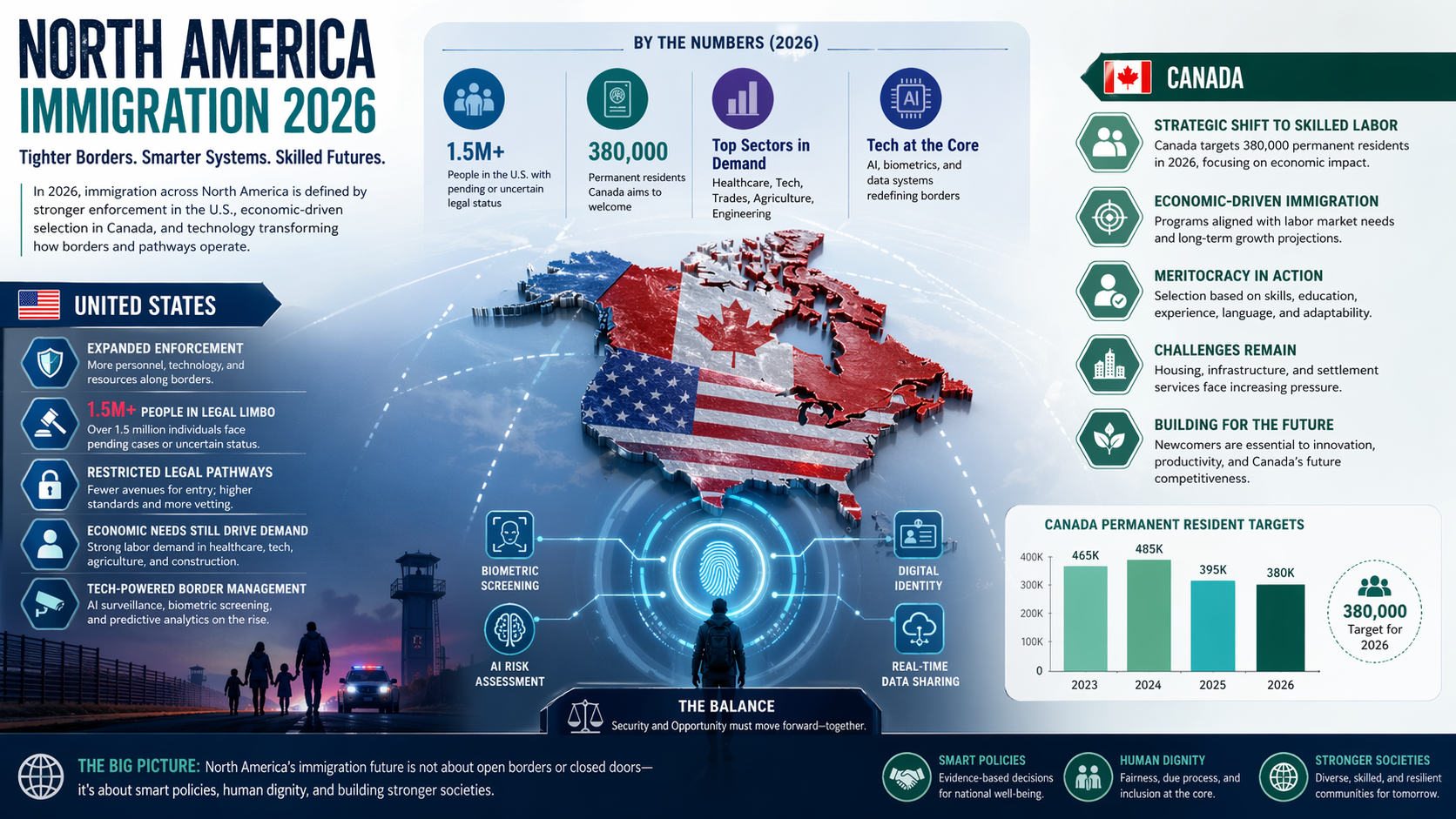
In 2026, immigration across North America reflects a period of tightening systems, shifting priorities, and increased reliance on data-driven governance. Across both the United States and Canada, migration is no longer only about movement across borders, but about managing labor needs, legal compliance, and national economic strategy in a more structured and technologically monitored environment.
In the United States, immigration policy continues to be shaped by expanded enforcement mechanisms and a growing backlog of individuals navigating uncertain legal status. Over 1.5 million people are estimated to be affected by pending or unresolved immigration cases, creating pressure on courts, detention systems, and administrative agencies. The focus has increasingly shifted toward border management efficiency, with digital surveillance tools, biometric screening, and AI-supported tracking systems becoming central to enforcement operations. These technologies aim to streamline processing and reduce illegal crossings, but they also raise ongoing debates about privacy, due process, and humanitarian responsibility.
At the same time, legal immigration pathways have become more selective, emphasizing skills, economic contribution, and labor shortages in key sectors. Employers in technology, healthcare, engineering, and agriculture continue to rely heavily on immigrant labor, yet the pathways to entry are more structured and competitive. This has created a dual reality: strong demand for foreign workers on one hand, and more restrictive entry systems on the other.
In contrast, Canada has leaned further into an economic-driven immigration model. In 2026, Canada targets approximately 380,000 permanent residents, prioritizing skilled professionals who can directly support long-term economic growth. The system is increasingly designed around labor market alignment, meaning applicants are evaluated based on education, experience, language ability, and sector-specific demand. Healthcare workers, tech specialists, and tradespeople remain at the center of this strategy, as Canada continues to address demographic aging and workforce shortages.
This approach has positioned Canada as one of the most structured immigration systems globally, where policy is closely tied to economic forecasting. However, it also presents challenges, including housing pressure in major cities, integration demands on public services, and ongoing debates about regional distribution of newcomers.
Across United States and Canada, a shared trend is the growing role of technology in border and immigration management. Digital identity systems, automated visa processing, and predictive analytics are increasingly used to assess risk, verify eligibility, and manage entry flows. These innovations aim to improve efficiency, but they also mark a shift toward more algorithmic governance of human mobility.
Another defining feature of 2026 is the widening gap between demand for migration and the availability of legal pathways. Economic globalization continues to drive labor movement, yet policy frameworks are tightening, creating tension between market needs and regulatory control. As a result, immigration is becoming less about spontaneous relocation and more about structured selection based on national priorities.
Overall, North American immigration in 2026 reflects a balancing act between control and opportunity. It is shaped by enforcement expansion, economic selectivity, and technological transformation, all unfolding within a broader debate about fairness, security, and the future of human mobility in an interconnected world.