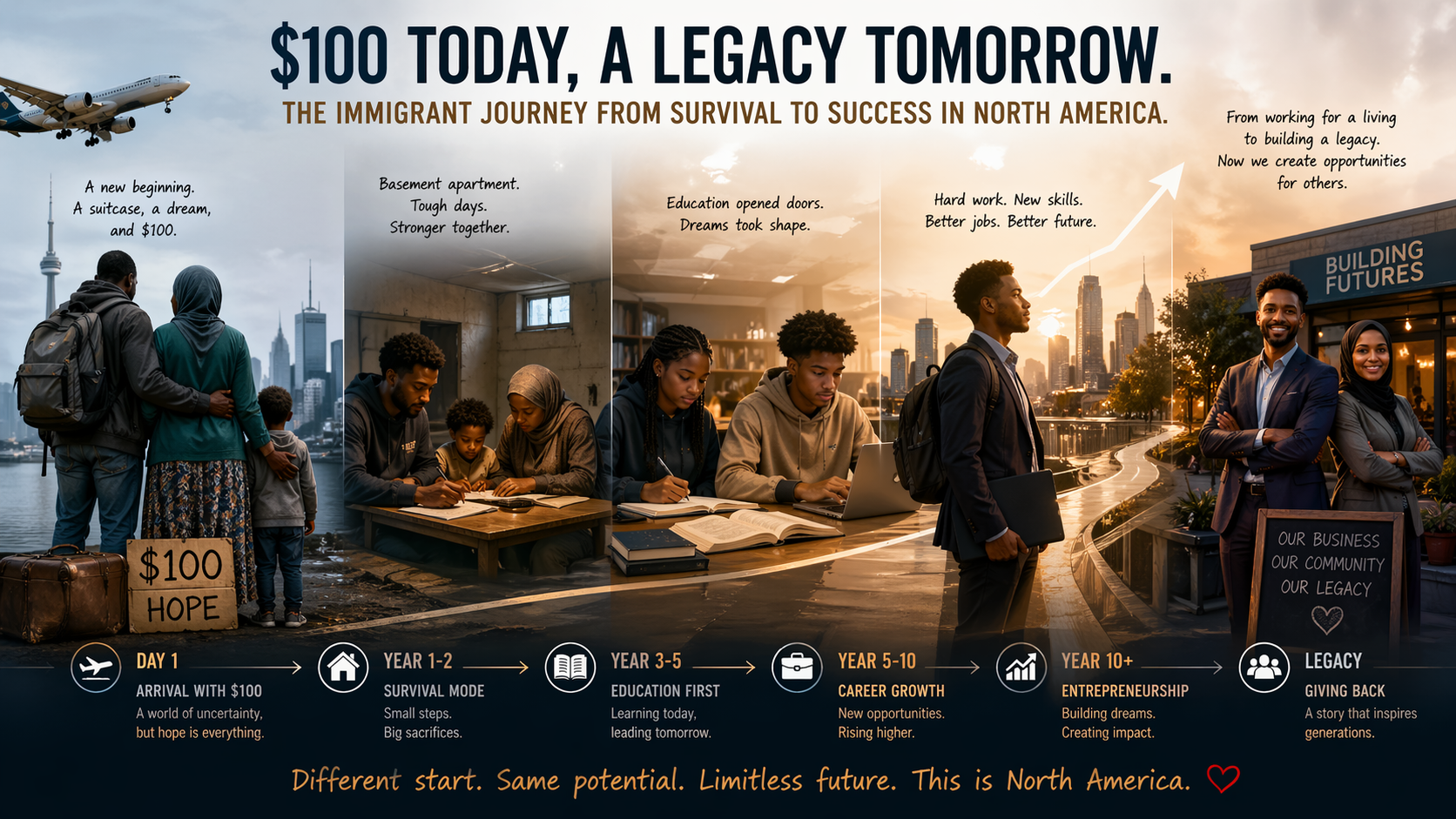
They arrive in North America as a family from East Africa with nothing but hope, a few clothes in a suitcase, and $100 carefully folded and counted more than once.
The first reality hits quietly.
Not the cold weather, not the unfamiliar roads—but the cost of living.
Where do they live?
At first, it’s a small shared basement apartment in a modest neighborhood—somewhere in cities like Toronto, Minneapolis, or Houston. The kind of place where the walls are thin, the furniture is borrowed, and every dollar is planned before it is spent. The father takes whatever work he can find. The mother stretches every meal. The children adjust faster than anyone expected, learning a new school system while still carrying memories of home.
Nothing feels easy. But nothing feels impossible either.
Because something else is happening in the background.
They are learning.
Not just in classrooms, but in life itself. The father takes night shifts and observes how systems operate—how schedules run, how businesses function, how reliability is rewarded. The mother learns budgeting like a new language, turning limited income into survival and slowly into stability. The children begin to adapt through education—at first struggling with accents and differences in teaching styles, then gradually excelling as confidence grows.
Education becomes the turning point.
One child stays late after school for extra help. Another discovers interest in science, technology, or business studies. Teachers begin to notice not where they started, but how quickly they are climbing. Scholarships, mentorship programs, and community support start opening doors that once felt invisible.
Years pass.
Five years feels like survival. Ten years feels like structure. Fifteen years begins to feel like transformation.
The family is no longer in the basement apartment. They move into a small rented home, then eventually buy their first modest house in a quiet suburban neighborhood. The children enter college—some becoming nurses, engineers, IT specialists, or accountants. The parents, once working entry-level jobs, step into more stable roles or supervisory positions, carrying with them years of resilience that cannot be taught in classrooms.
And then something powerful happens.
Career becomes independence.
One of the children enters the workforce and realizes something important: stability is not just about employment—it is about ownership of direction. Promotions come. Networks expand. Experience compounds. They are no longer just adapting to North America; they are shaping their place within it.
But the story doesn’t stop there.
Because after years of working, saving, learning, and observing, something begins to form—an idea. A small service. A side hustle. A gap they noticed in the market. It starts cautiously, often in evenings or weekends, built on discipline learned through years of struggle.
Then it grows.
A cleaning service. A logistics company. A tech solution. A small retail business. It does not matter what form it takes at first—what matters is that it begins.
And slowly, the same family that arrived with $100 is now creating jobs for others.
This is the part that is often misunderstood.
Immigrants from East Africa—or anywhere—do not arrive in North America to remain at the margins. They arrive to move. To shift. To grow. Their upward mobility is not instant, but it is consistent. It is built through education systems that reward persistence, labor markets that reward skill development, and economies that when accessed fully allow effort to compound over time.
What looks like “starting over” is actually building forward from a different foundation.
And perhaps the most inspiring truth is this:
It is not the $100 that defines their beginning.
It is what they refuse to give up when that $100 is gone.
Because in time, the story changes from survival… to stability… to success… to contribution.
And eventually, to legacy.