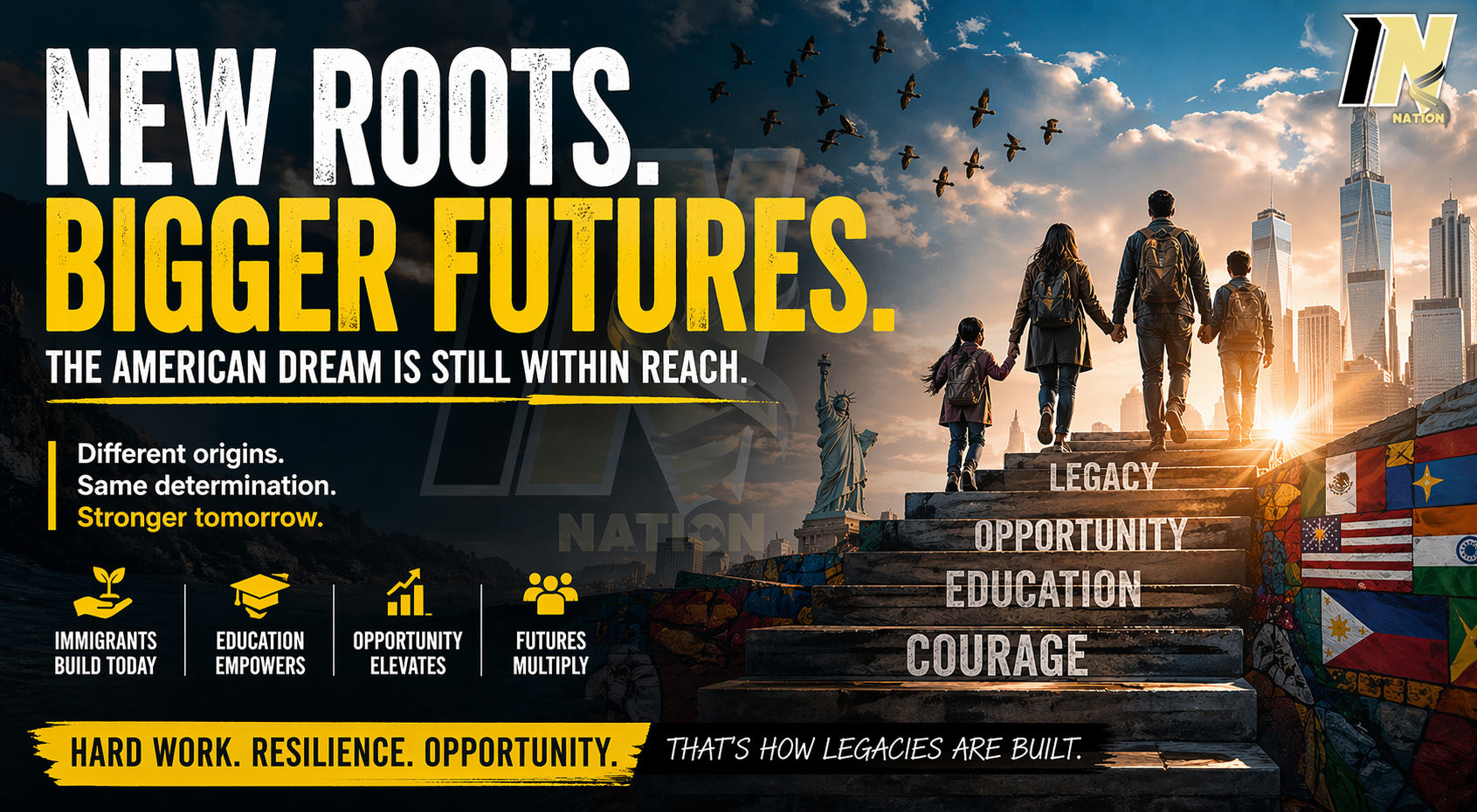
For generations, the American Dream has represented something deeply powerful—the belief that no matter where you come from, with hard work, resilience, and opportunity, you can build a better life. For immigrants arriving in North America, this dream has always been more than just an idea; it has been a reason to leave behind comfort, familiarity, and sometimes even family, in pursuit of hope.
In recent years, many people have questioned whether that dream still exists. Rising living costs, economic uncertainty, housing challenges, and shifting immigration policies have made some wonder if the promise of upward mobility is still realistic. Is the American Dream still accessible, or has it become a story of the past?
Interestingly, research continues to offer a hopeful perspective. Studies show that despite having very different backgrounds and origins, the children of today’s immigrants are climbing the economic ladder at rates similar to the children of historical European immigrants who arrived generations ago. This is significant because it proves that while the path may look different, the possibility of progress remains very real.
Families arriving from Africa, Asia, Latin America, and the Middle East often begin their journeys with enormous challenges. Many start with limited resources, language barriers, and the pressure of adapting to an entirely new system. Parents may work multiple jobs, take positions below their qualifications, or sacrifice personal ambitions so their children can access better education and opportunities. Their success is often measured not by immediate wealth, but by the foundation they create for the next generation.
This is where the real story of economic mobility begins. The first generation often plants the seeds, while the second generation reaps the harvest. Children of immigrants frequently grow up understanding sacrifice firsthand. They become translators between cultures, navigating both the traditions of home and the expectations of the society around them. They often carry a unique sense of responsibility—the understanding that their success is not just personal, but generational.
Assimilation plays a major role in this journey, but it should never be mistaken for the loss of identity. True assimilation is not about abandoning culture; it is about learning how to succeed within a new environment while preserving the values that define who you are. It is the ability to speak two languages, understand two worlds, and turn that dual perspective into strength.
This balance creates something powerful. Immigrant communities are often known for resilience, entrepreneurship, and innovation. They open businesses, support local economies, create jobs, and strengthen neighborhoods. Many of the world’s leading professionals, founders, healthcare workers, and educators are the children of immigrants who grew up believing that education and discipline were non-negotiable.
Still, the journey is far from easy. Many immigrants continue to face systemic barriers such as discrimination in employment, unequal access to housing, limited healthcare, and the emotional toll of separation from loved ones. Legal challenges and documentation issues can create constant uncertainty. For some, success takes years longer than expected. For others, it requires starting over entirely.
Yet history consistently shows that persistence changes outcomes. The immigrant story has never been one of convenience; it has always been one of courage. It is about rebuilding identity, redefining purpose, and refusing to let temporary hardship determine permanent destiny.
The American Dream itself has also evolved. Decades ago, it was often defined by owning a home, having a stable job, and raising a family in financial security. Today, it includes entrepreneurship, remote work, digital careers, personal freedom, and building generational wealth. For many immigrants, success is no longer only about survival—it is about legacy.
A mother working night shifts so her daughter can attend university. A father driving long hours so his son can start a business. A young graduate becoming the first in the family to earn a degree. These are not isolated stories; they are everyday examples of the Dream in motion.
Immigrants are not simply chasing opportunity—they are reshaping what opportunity looks like. They are contributing to economies, strengthening industries, and proving that diversity is not a challenge to progress, but a driver of it. Their stories are reminders that success does not always begin with privilege; sometimes it begins with sacrifice.
The question should no longer be whether the American Dream is still alive. The better question is how it is being rewritten by those bold enough to pursue it. And the answer is visible in communities across North America every single day.
The Dream is still alive, but it looks different now. It is found in resilience rather than comfort, in sacrifice rather than shortcuts, and in long-term vision rather than instant success. It lives in the hearts of people who leave everything familiar behind because they believe their children deserve something greater.
For immigrants, the American Dream is not a guarantee. It is a commitment. It is waking up every day and choosing hope over fear, progress over limitation, and faith over uncertainty.
Perhaps that is what makes it so powerful.
It begins with one simple belief: my children will have a better life than I did.
And for millions of immigrants, that belief is still enough to keep the dream alive.